
Yamaha Tenere T7 vs BMW F 900 GS: a comparison.
I’ve owned both bikes for quite some time, and at some point, I found myself torn between keeping one or the other. That’s why I decided to compile my thoughts, emotions, and impressions in one place to help me make a decision and share it with you. For clarity, I’ll use a simple points system: in each section, I’ll give a point to one bike or both.
Let’s start by introducing the bikes: Yamaha Tenere Rally (2022) and BMW F900GS (2024). First, let’s look at the dry numbers.
Specifications:
| Yamaha Tenere T7 Rally: | BMW F900GS: | |
| Weight: | 204 kg | 219 kg |
| Seat height: | 895 mm | 870 mm |
| Tank capacity: | 16 L | 14.5 L |
| Engine: | a parallel twin, producing 73 hp and 68 Nm with an 11.5 compression ratio | Engine: a parallel twin, delivering 105 hp and 93 Nm with a 13.1 compression ratio |
| Wheels: | 21/18, tube-type, with classic spoke lacing to the centre of the rim | Wheels: 21/17, tubeless, with spokes laced to the outer edge of the rim |
| Suspension travel: | 210 mm front, 200 mm rear | Suspension travel: 230 mm front, 215 mm rear |
| Trail: | 105 mm | 119.8 (120) mm |
| Notes: | The 2022 model is the last year of the Tenere with the old-style dashboard, which is essentially the benchmark of that “simple and reliable Japanese bike” we all envision. | This 2024 model comes equipped with all the modern electronics you’d expect today. |
Appearance
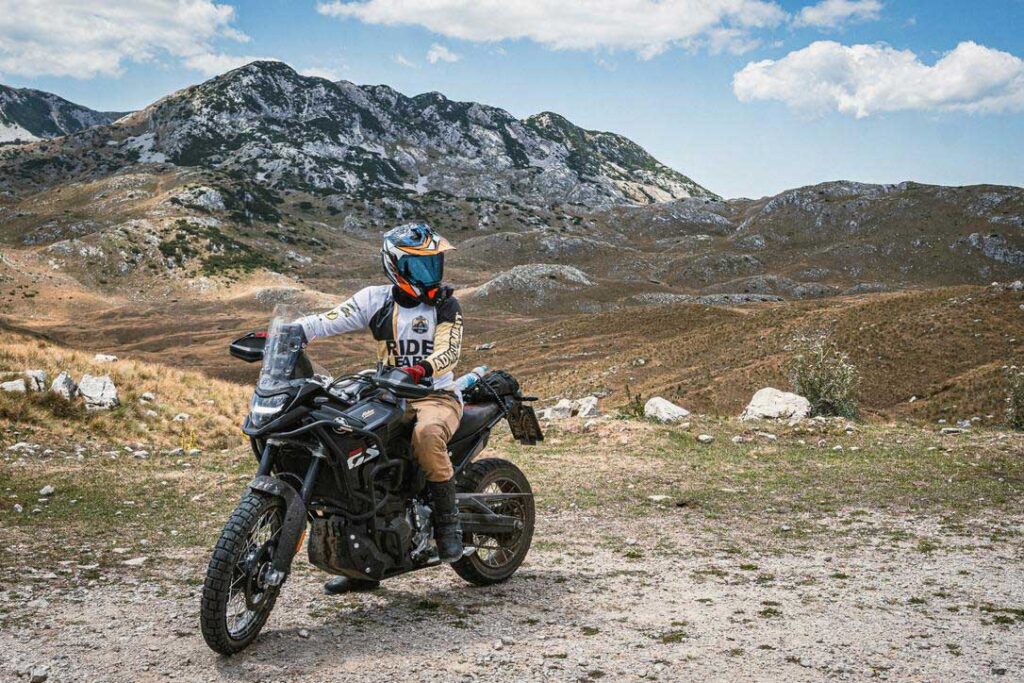
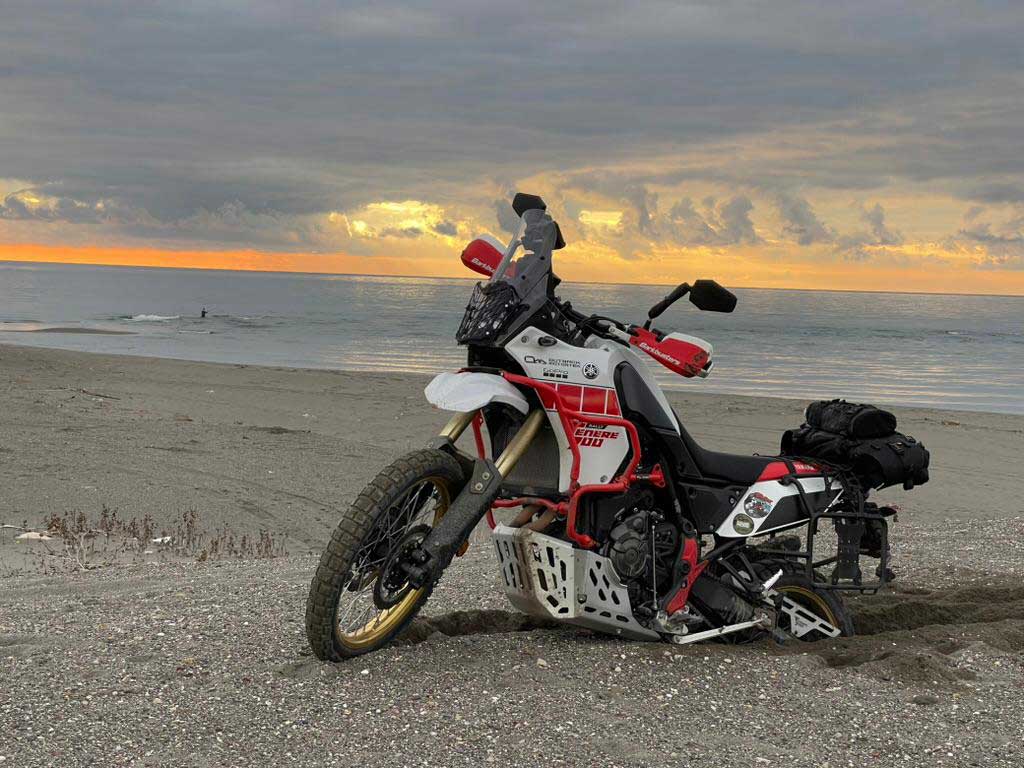
Personally, I prefer the Tenere silhouette. It looks much better, especially in the 2022 rally livery. Both bikes come from the factory with Akrapovič exhaust systems, and both sound great. As for the BMW, I like the black colour the most out of the 2024 options, even though I generally don’t like black bikes. Either way, both bikes have a sharp and good-looking silhouette.
Let’s be honest and call this one a 1:1 comparison, even though I personally prefer the Tenere.
Engine.
The Tenere engine is the reliable CP2, which has been on the production line for over a decade. It’s known for its exceptional durability. The engine produces 73 horsepower and almost 70 Nm of torque, which is available pretty much from the bottom of the rev range. This makes it great for off-road riding. Sometimes, you can literally ease off the clutch and tractor your way through obstacles in first gear.
However, on the highway, the engine can feel like it “runs out.” Passing power may not be enough, and you often have to drop a gear or two. But you can’t call Yamaha weak; it’s more that there isn’t much power in reserve. The direct throttle response makes the engine very predictable and comfortable in any conditions. Since there’s no ride-by-wire here, there are no ride modes either. Fuel consumption: the manufacturer claims 4.3 L/100 km, but with my riding style, I’ve never seen less than 5.5–6 L/100 km. The engine sound is nice and clean, though the signature CP2 “rattle” slightly breaks the idyll.
BMW’s F-engine family conceptually traces its roots back to the Rotax era. However, the engine on the F900GS is a different story. It’s the development of the 850-series platform, which has been in production since 2018 and has had ample time to prove itself. Moreover, the 895 cc version has been used on the F900R/F900XR since 2020, further solidifying its reliability and trustworthiness. With 105 hp and 93 Nm, the engine delivers a satisfying performance, especially when combined with the new throttle tuning. This tuning provides a direct and sharp response, eliminating the excessive damping that often bothered me on other BMWs. Whether on the trail or on the asphalt, the engine exhibits remarkable elasticity, ensuring ample power for any riding situation. While passing is effortless, it’s worth noting that the bike has a rather nervous character. Smooth and calm riding becomes possible only after one gets accustomed to its dynamic nature.
Fuel consumption, as claimed by the manufacturer, is 4.4 L/100 km. However, I rarely manage to achieve less than 6.5. Regarding sound, the distinctive “dirty” signature of the 850-family remains unchanged. It continues to rattle and clatter, with the clutch basket sound being particularly prominent. While it may take some time to get used to, the exhaust sound usually drowns out any complaints during riding.
In this aspect, BMW undoubtedly emerges victorious. 2:1
Moving on to comfort, ergonomics, and seating
Let’s be honest: neither of these bikes is particularly comfortable. Both lack adequate touring wind protection, and the Tenere rally seat serves primarily as a cover for the electronics and battery compartment. However, if we consider comfort from that limited perspective, let’s delve deeper.
Both bikes have a straight, relaxed riding position. The Tenere handlebar is noticeably narrower, which might feel unusual if you’re coming from other bikes. The Tenere dashboard is simple but provides all the necessary information. However, that’s not as relevant now because the dashboard has changed since 2023 and looks different. My personal complaint is that the (admittedly simple) onboard computer is controlled by the right switchgear, making it almost impossible to use while riding. Yamaha fixed that only in the 2025 update by moving the controls to the left side. Wind protection is sufficient; you don’t feel the urge to lie on the tank. Standing riding is comfortable in any mode; your legs naturally fall into a good position. The footpegs are placed well, and your legs don’t go numb even on longer rides.
Now, let’s talk about the BMW. The display is the standard modern BMW one: clear graphics and easy to read. You control the onboard computer via the left switchgear and the “wonder ring.” The heated grips button is separate, and I’m glad the F900GS isn’t as overloaded with electronics as bigger BMW models. The switchgear isn’t ridiculously busy. The seat is more comfortable than the Tenere’s, but still rather firm, even though it’s wider. You won’t sit on it forever because your butt goes numb. Wind protection, even with the optional tall screen, leaves a lot to be desired. At speed, it’s noisy, and you want to tuck in. The wind hits your chest hard, which played a bad joke on me during a long trip across Italy in November. Knees are a bit more bent than on the T7, but still comfortable. Standing is good: your legs grip the ribbed plastic side panels well. However, when riding uphill and needing to move your weight forward, problems start. The tank is wide and slippery; you lack contact, and some weight ends up on the bars. I think tank pads would fix a lot.
In this section, I wouldn’t give anyone a point. The score stays 2:1.
Now, let’s talk about road behaviour.
The Tenere on stock suspension is noticeably stiff and feels like a kart. However, it holds the road well and provides adequate wind comfort. The front brake is informative, but I would prefer stronger braking. The rear brake feels spongy and lacks sharp reactions, which can be attributed to its off-road focus, where control is spread over a wider range. In city traffic, the narrow handlebars and overall height, combined with the short trail, make it very nimble and great for lane-splitting. You might expect reduced high-speed stability as a downside, but surprisingly, it remains quite stable at speed. Engine vibrations are low, and nothing much comes through the bars.
The main complaint on asphalt is power: it’s not always sufficient for sharp passes without extra effort. In general, the engine feels, sounds, and performs best above 5,000 rpm. Another issue is the headlight: it’s not sufficient, especially in corners. You would benefit from adding auxiliary spots, which is somewhat ironic considering the four projector lenses up front. A 16-litre tank provides approximately 250 kilometres of confident range, prompting you to look for fuel. While it may be inconvenient, it serves as a convenient “built-in” break point for long highway runs. The T7 has minimal safety features beyond ABS, forcing you to be more cautious and deliberate in your actions. With my riding style, the bike often veers out under hard acceleration or cornering, but that’s solely on me.
It’s worth noting that newer model years introduced traction control and ride-by-wire with ride modes.
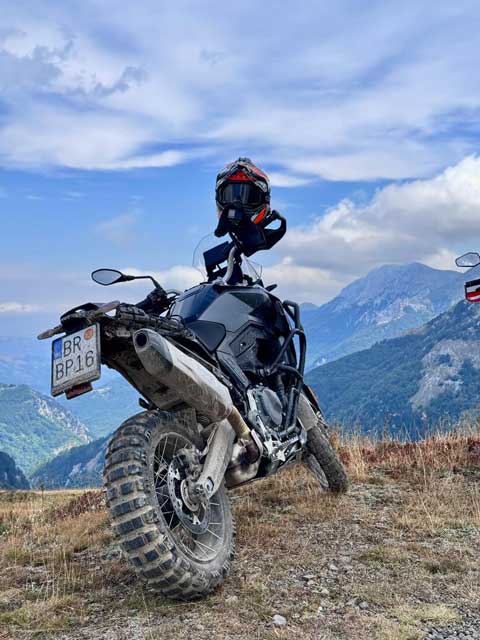
The BMW offers a more exhilarating riding experience on asphalt compared to the T7. The significant power boost of nearly 50% is immediately noticeable, infusing the bike with a playful and mischievous character. It constantly urges you to accelerate harder, brake later, and maintain a lower gear. While you can tame it if desired, it feels like that’s not its natural inclination. This bike thrives on dynamic riding, and it’s most comfortable when you embrace its dynamic nature. On long rides, extra chest wind protection and earplugs become indispensable, as high-speed riding can become uncomfortable otherwise. Despite these challenges, the engine-gearbox combination maintains its speed well, and the comfortable cruising pace is clearly superior to that of the T7.
The suspension boasts a wide adjustment range, allowing you to customize it to resemble a kart or adopt a more “sofa-like” stance. Regardless of your preference, it effectively holds lines and corners. The trail is slightly longer than the T7, which may reduce its nimbleness but enhances its stability. The stock steering damper plays a crucial role in this regard. The bike pulls well across the entire rev range. Electronically, it offers all the features that a modern bike should, including adjustable ride modes, a bi-directional quickshifter, and cruise control. When necessary, the bike actively protects its rider. However, there are a few drawbacks to consider. First, engine vibration transfers to the bars, although it’s not a significant issue. For me, the F900GS was the first bike that caused numb hands and “pins and needles” after a prolonged high-speed highway ride. Second, the 14.5-liter tank provides only about 200 kilometers of range with aggressive riding. Fuel becomes a concern after 120-130 kilometers. In calmer riding conditions, you can reach the station after 200 kilometers. Nevertheless, this bike is not designed for long highway slogs due to wind protection and the limited tank capacity.
Considering all the pros and cons, the BMW emerges as the superior choice, with a 3:1 advantage.
And now, the best part — off-road capabilities.
The Tenere seems like a bike that has nothing to discuss about this topic. It’s designed for off-road riding, and it excels in that area, especially when handled by skilled riders. However, its high center of gravity, tall seat, and clutch that requires proper technique make it challenging for beginners. I personally dropped it a few times when I started riding, even on flat ground. Shorter riders often struggle in technical off-road spots due to their height.
On the positive side, the Tenere T7 is stable and reliable. The downside is that the rear brake pedal isn’t adjustable, so you have to tweak it manually for off-road riding. Additionally, the ABS off button disables both circuits and resets when you switch the ignition off. Dongles exist to fix this issue, but it’s still annoying. Newer models supposedly address this problem.
The suspension is very energy-absorbing, allowing you to ride hard without worrying about the bike’s handling. While it may feel insufficient for a pro rider, most T7 owners can’t even use the full potential of the stock suspension. For those who want more, the aftermarket offers a wide range of options. The 21/18 wheels handle any surface, and while some worry about tubes, I only punctured a wheel once in 35,000 km of riding, so it’s not a major concern. The centre-laced rims feel stiff and strong, which is a definite plus.
The engine is perfect for off-road riding. The torque helps you control and feel the bike, making it one of the best off-road-capable bikes in the world. Standing riding is great, and moving around the bike feels natural. The exhaust sound is simply a joy.
The F900GS is essentially a Tenere with enhanced performance. It boasts increased power, and its stock suspension system functions more effectively, even without the enduro package. Additionally, the travel distance is slightly longer. Two enduro engine modes are beneficial for beginners. The Standard Enduro mode limits power and modifies ABS/traction to allow some sliding and wheelspin. However, for a genuine off-road “battle,” the Enduro Pro mode is recommended. In this mode, you have the freedom to control the extent of electronic intervention (or lack thereof) and set the throttle response and power behaviour. A convenient feature is the adjustable brake pedal, which can be switched for standing riding with a simple move.
One downside is its high weight, although it feels lighter than the T7 due to its lower centre of gravity. Another off-road limitation is the 17-inch rear wheel, which restricts tire options. For instance, I couldn’t fit a Dunlop 908RR. In obstacle riding, I don’t perceive significant differences; let the experts decide. A more serious drawback is the outer-edge spoked rims. First, they scratch faster due to the protruding lip, and second, in my experience, they bend more easily than the T7’s. Low tire pressures aren’t a viable option unless you’re comfortable with constantly straightening or replacing the rims.
Despite these drawbacks, the bike performs exceptionally well off-road. It excels over large hits, handles slow manoeuvres, and maintains its speed. It jumps well and responds effectively. However, the wide tank makes it less convenient to shift weight forward when climbing hills.
In this section, each bike earns its points, resulting in a score of 4:2, which is a convincing victory for BMW.
Conclusion
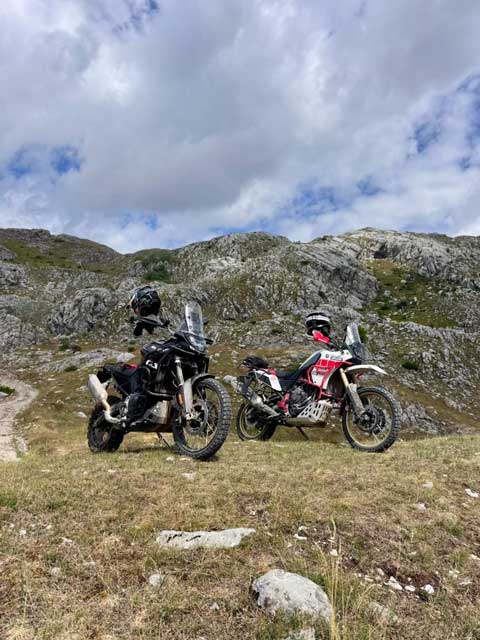
So, what’s the conclusion? Both bikes are exceptional. I’m pleased that BMW replaced the genuinely weak and peculiar F850GS with a new generation that is genuinely focused on off-road performance and has proven successful. The Yamaha Tenere remains a recognised classic, although I believe the platform is due for an update. Yamaha is more affordable and less powerful, but it still feels more reliable and, yes, more aesthetically pleasing. BMW offers greater power, higher cost, and modernity, albeit with its own set of flaws. While writing this, I made my final choice in favour of BMW. It’s more versatile, evokes stronger emotions, and remains more comfortable thanks to modern technology.
What would be your choice?